Thursday, 17 December 2015

Some Interesting photo history.

Reading about ships of the Waratah period is not enough and leaves a lot to the readers imagination of what things really looked like. I have put a series of photographs from my personal collection to help readers to understand how things appeared in that period.  (note all photos are copyright and may not be used without my express permission).
We often read about ships carrying coal on deck for extended voyages but never see what coal on the deck really looks like, in this example I have selected two pictures involving the Ropner's tramp steamer Burnby  built in 1905.

About 250 tons on hatch No 1 and 2.
 
            s s Burnby,  Ropners  Steamship Company sank by U boat 39 North of Sardinia 1917.
 
                                  A bunker fire with smoke coming up through bunker grating.


         Passengers boarding Lund's ss Commonwealth in London. Note life boats not painted white        also another Lund ship in picture s s Geelong.
 
                              s s Commonwealth leaving London docks with third class passengers.
 
                                                    s s Commonwealth arriving at Adelaide.

        A beautiful ship, sister ship to the Geelong the s s Commonwealth discharging ballast water.

                                 s s City of London often mistaken for the Waratah at sea.
Note the high vents on the fore deck and similar wheelhouse.

In My Next post I shall put up some more interesting pictures of the Waratah period. The s s Commonwealth eventually had her lifeboats painted white at a later stage.


Tuesday, 8 December 2015

Waratah

One of the passengers on the first voyage wrote to the press the following.
To the Editor,
Sir, since this vessel arrived in Australian waters the company has raised the price of a pint of ale from 6d to 1s., quarts to 1s 6., and whisky 6d to 8d, Don't you think this is red hot, seeing we are only poor third class- class passengers? By the way, what is the duty the company have to pay in comparison to the extra charge they have put on us? We have been supplied with the cheapest bottled beer to be had in England during the voyage, with the exception of now-we are using a reputable brand, as all the other has run out. Another thing, this vessel is apparently top heavy, and I consider she's dangerous, as the way she rolled since leaving Capetown is a fair caution. Over 80 dozen glasses have been broken alone, besides other gear in proportion, Yours etc a third class passenger. It's interesting to note that Mr Skailes the chief steward received a percentage of all beers and spirits sold, no doubt he had his hands out on this one.
 
 
Beers of the period.
 
WARATAH AND HER FREEBOARD.
 
Waratah had a free board of 8 feet which was assigned to her by Lloyds and considered high enough above water level for a ship of her dimensions. The calculation of freeboard is a complex one worked out by the naval architects that made up the board in authority such as Lloyds and the Board of Trade. It would not matter if her freeboard had have been slightly higher she would have still shipped green water at some stage. Some ships have open rails on the lower well decks which help greatly in green water shipped running off quickly. The Waratah had plated bulwarks 4feet 2inches high instead of open railings. These bulwarks had three wash ports on either side of the well decks to allow the water shipped  to run off through, as well as scupper pipes to help the final draining of the water. These wash ports consisted of swinging hinged steel flaps that opened outward to let the water off the deck. They measured 3feet 6inches wide by 1foot 6inches high.
 
 
                                     A wash port with a ring bolt to hold it open if need be. 
 
One ship I was on had high bulwarks with wash ports and every time we shipped green water the well deck would fill up and before the wash ports could clear the amount of water shipped, another one would come over and you could feel the ship labouring and trying to rise to the sea with the extra weight, this was because they had not been maintained properly and did not open fully, they were partly frozen on their hinges. I took photos of the seas over the deck and when I returned to our home port I complained to the marine superintendent that it was dangerous and we could lose a man overboard, not only that, the ship was slowed up and straining and using far to much fuel according to the engineer and putting our E.T.A behind. In shipping time is money, thankfully he saw the problem and went back to head office to report our complaints. He appeared the next day and we decided remove the wash ports completely and weld three evenly spaced bars across the now new openings to prevent a man being washed through the open ports. Evidently the bean counters at head office didn't like the idea of extra fuel costs never mind about the added weight we had to struggle with or the poor bugger that might be swept overboard.. Eventually it proved worth while and the ship seemed a bit easier to handle and less strain on her. I believe according to the engineers figures the fuel bill over a year was reduced by at least 3%,
not a bad saving dollar wise.
With the Waratah and her forward well deck,  if she shipped green water and was unable to get it to run off before the next wave came over she would be weighed down by 250 tons of water by calculation, and this is with the cubic volume of the large hatch coaming subtracted. She was hard to steer under  favourable circumstances, can you imagine the after well deck filling up at the same time, I would say she would have been close to un-manageable steering wise. She had enough buoyancy when leaving Durban according to her draught, and she was no where down to her load her load line rated at 30 feet 4/2 inches.
 
            Open rails, water managing to run off more freely than a ship with plated bulwarks.
 
                                                               Open ships railings.
 
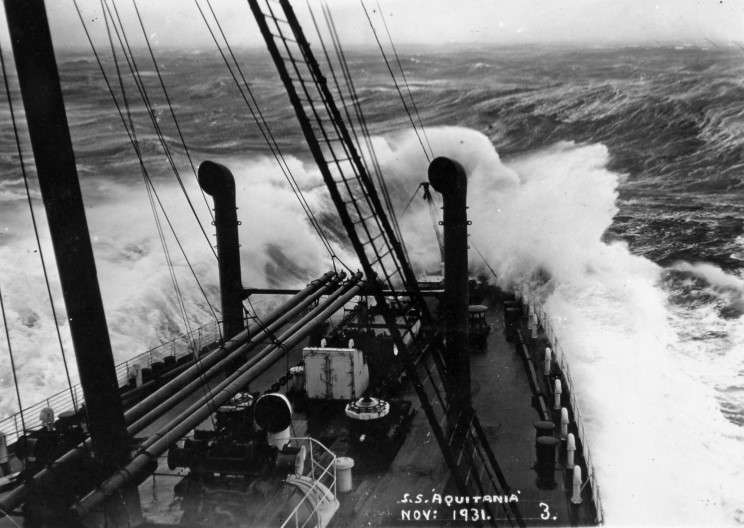
Let us now take a look at a larger ship than the Waratah with a much higher freeboard, the Aquitania was a large ship in her day with a very high freeboard  and she measured 901 feet long by 97 feet beam with a draught of 36 feet.
 
                                                  Aquitania with a very high freeboard.
 
                                                  Aquitania burying her bows into it. 
 
                        Aquitania getting rid of a green one , note the wash port at lower left of photo. 
 
It is interesting to note that the Clan Macintyre 2 during the storm had to open her gangway gates on her bulwarks to help get rid of some of the green water she was shipping.


Sunday, 22 November 2015

A rather insulting email .

To my Readers,
from all the many emails I receive on a daily basis regarding shipping matters and also the ss Waratah, I can honestly say I am disgusted by the one sent by Andrew Van Rensberg whom I have on the odd  occasion  pointed out mistakes (obvious ones) in some of his blogs. It reads as follows,
So glad your health is improving. MOLE, who is a female yes, has her own blog, MOLE'S GENEOLOGY BLOG. When the bickering is all said and done and I am unilaterally put in my place by an EXPERT, take a moment to read MOLE'S posts. They are informative accurate and most importantly an example of how to set the bar high. We can all learn from this,...... enough for now, back to my task of 'sweeping statements and feeding the public incorrect figures. Take care.

A lot of people are aware of your figures etc, Having insulted me privately Andrew, you start sending me emails about my earlier blogs being complimentary and now in public in your blogs, you are praising my posts in an acclamatory manner a far cry from earlier comments in the public forum, calling me a spoilsport, agreeing with MOLE that I am a nit picker. Attack is always a good means of defence when you are made aware of your short comings. However I shall continue to write on with good grace and dignity , but in the meantime  I would like to point out that I do not wish to have my name used in your posts in future for whatever means, or to be associated with  you in way whatsoever.   Captain S. J. Robinson.
To those that follow my posts I will be posting this week once again, and have some interesting articles lined up for you, and thank you to those of you that have offered kind words of support.
     

Wednesday, 11 November 2015

Top heavy ships, add some ketledge.

 
Ketledge, usually comes in the form of pig iron billets and was often used as ballast in larger ships. Ballast comes in many forms and did so before the introduction of water ballast in early steamships. Sand , mud, rocks, and foundry dross were often used but the effort of loading it and discharging it by shovel was costly and time consuming on ships wishing to spend less time in port. I was not aware of foundry dross until I spent some time on Ascension Island in the South Atlantic Ocean. During my stay en-route to South America. I became friendly with one of the local inhabitants who brought to me one day what appeared to look like a piece of clinker (hardened ash or partly burnt coal) from a ships furnace.  It had speckles of what I thought was brass in it and the local thought it was gold and it was very heavy for its size about 5 inches in diameter and 1inch thick. We took a hacksaw to it and found more of the shiny metal was right throughout . He told me that he was diving and came across a massive patch of it in amongst some old ships timbers, he also produced some heavy copper fastening bolts. It was now obvious that he had found and early shipwreck, and naturally kept the spot to himself. I was very curious as to what the clinker could be and at his request would I take a sample with me to determine what it was. This I duly did this and after eventually arriving in England on my way home, took it a marine archaeologist who informed me that it was dross from a foundry that probably  cast bronze cannons and fittings for early sailing ships and was used as a heavy ballast in wooden vessels. The main content in the dross was bronze and I duly messaged my friend on the island and he  replied that he was going to salvage the remainder for the bronze content as scrap metal. This was my first lesson in unusual ketledge as I knew it.  
 
                                                   Unstable M.V. Rangitiki.
The M.V. Rangitiki was a New Zealand  passenger ship one of three in the same class, launched on the 29th of August 1928 ,on sea trials she was found to be unstable in ballast. Before her maiden voyage was undertaken some topside weight was removed. Modifications were made which included the removal of two sets of Samson posts, (Strong pillars fixed to the deck for the support of ships derricks). On the 31st of January 1929 she was taken over by her owners and set sail for New Zealand on February 15th 1929 taking 5 weeks for the voyage. During the 1st voyage stability problems were still found to exist and on her return to England she underwent further alterations. These consisted of removing most of the bridge structure including the associated deck, shortening of her two funnels and the installation of additional permanent ballast. After this the ship went on until scrapped in 1962. 
                                                        Rangitki with high funnels.
                                                  Rangitiki with cut down funnels.
 
The ss Imperator.
On her sea trials stability issues were discovered but she still sailed on her maiden voyage from Germany to New York on the 10th of June 1913. On her arrival at New York the pilot Captain George Seeth noted that the ship listed from side to side when helm changes were made to her change of direction. It wasn't until October 1913 that the Imperator  was returned to the ship yard that built her to have alterations made to improve her stability which was caused by her centre of gravity being to high. The marble bathrooms in 1st class were removed along with all heavy furniture and replaced with light cane furniture. Her funnels were reduced by 9.8 feet (3metres) and 2,000 tons of concrete were poured into her double bottoms as fixed ballast.
I
 
                                   Imperator (leaning Lizzie docking at New York.
 
                                            A true birds eye view of the Imperator.
The ss Principessa Iolanda.
The ss Principessa Iolanda was launched in Italy at 12.25 pm on the 22nd of September 1907 and was almost at the completion stage. After leaving the slipway the ship became unstable and heeled over to port. Some 20 minutes later the vessel began taking in water (Downloading) through open ports. She eventually capsized and lay at 90 degrees. There were many errors caused during her launching but the main error seems to be launching an almost complete ship without ballast, it was denied that it was due to her design.
                                                      ss Principessa Iolander
                                                     Launching in progress.
                                                                 Starting to take water.
At rest at 90 degrees, could you imagine the Waratah recovering from this with cargo on board that would have shifted in heavy seas along with water rushing in through her vents and openings. It would appear beyond any shadow of doubt that in this case the righting lever (GZ) is no longer apparent. Hope the men in the picture are not looking for it.(please excuse my sense of humour). Readers can view Wikipedia for information on the three ships mentioned here.
 
                                                   A comment on stability.
You can play around with all the figures on the stability of the Waratah but I am convinced that not all the true figures were not  put into the public arena, if she was such a wonderful stable ship what happened to her? It is impossible to thoroughly determine the stability of any particular ship using commonly published specifications. It must be remembered that stability is so complex and influenced by so many factors that even professional ship designers find it hard to quantify. Before computers were available the calculations involved were so complicated that certain aspects of stability were only estimated rather than accurately determined. When reading the figures on the Waratahs stability presented to the court this is what precisely happened. In this present age of computers doing the workload on numbers, stability calculations are one of the most trying tasks the naval architect has to contend with and perform.   


                                                                      .


Monday, 9 November 2015

To the many readers that follow my blogs.

Thank you to all those readers for their lovely get well emails. I have had a spell in the sick bay but my doctor assures me that I am not ready to pass over the bar just yet. It is so nice to be back on deck and  in the relative comfort of my quarters once again. To those readers that sent emails regarding information on ships in general and also queries on the Waratah, I have cut back my work load but will get around to answering you in the near future. To those of you  requesting information as to where you can find information on the Court of Marine Inquiry, there is a 23 page annex to the full report of the ss Waratah available on line. I must remind you however it is only a short annexure but will give you some interesting reading on the case. The full report is held at the Guild hall in London and is a very lengthy document indeed. If you go to Google and type in "Wreck report for Waratah', 1909-Port Cities Southampton you will bring it up, (the short annexure only).
 
During my absence I have evidently been a naughty boy for pointing out some of the mistakes that Andrew Van Rensberg has posted in some of his blogs, especially a recent blog "Waratah continued part 8". Readers can refer to the comments on this blog and make up their own minds. One blog which I have taken exception to was posted by a female who blogs under the name Mole, in her blog she had the following to say to me. "Pointless having a go at Andrew who is producing an informative and unbiased blog for our delectation and delight. If anyone wants to take issue with the nuts and bolts of the stats, fine. There is such a thing as nit picking. Anyway we're all on the same side- that is the Waratah- aren't we"?
My answer is yes Mole, and in reply to your arrogant response we are on the same side when it comes to the Waratah, nit picking as you call it has saved many lives at sea, someone has to take issue with loose nuts and bolts otherwise everything comes loose and eventually falls apart. If my constructive criticism is seen as nit picking so be it, the public is entitled to correct information and there is no room for loose nuts and bolts. I will not see readers fed incorrect figures or sweeping statements thrown around loosely on nautical matters whatever the ship being discussed, (near enough is not good enough).

To my dedicated readers, my next blog will be on stability in a form you will readily understand, until then once again thank you for your good wishes.

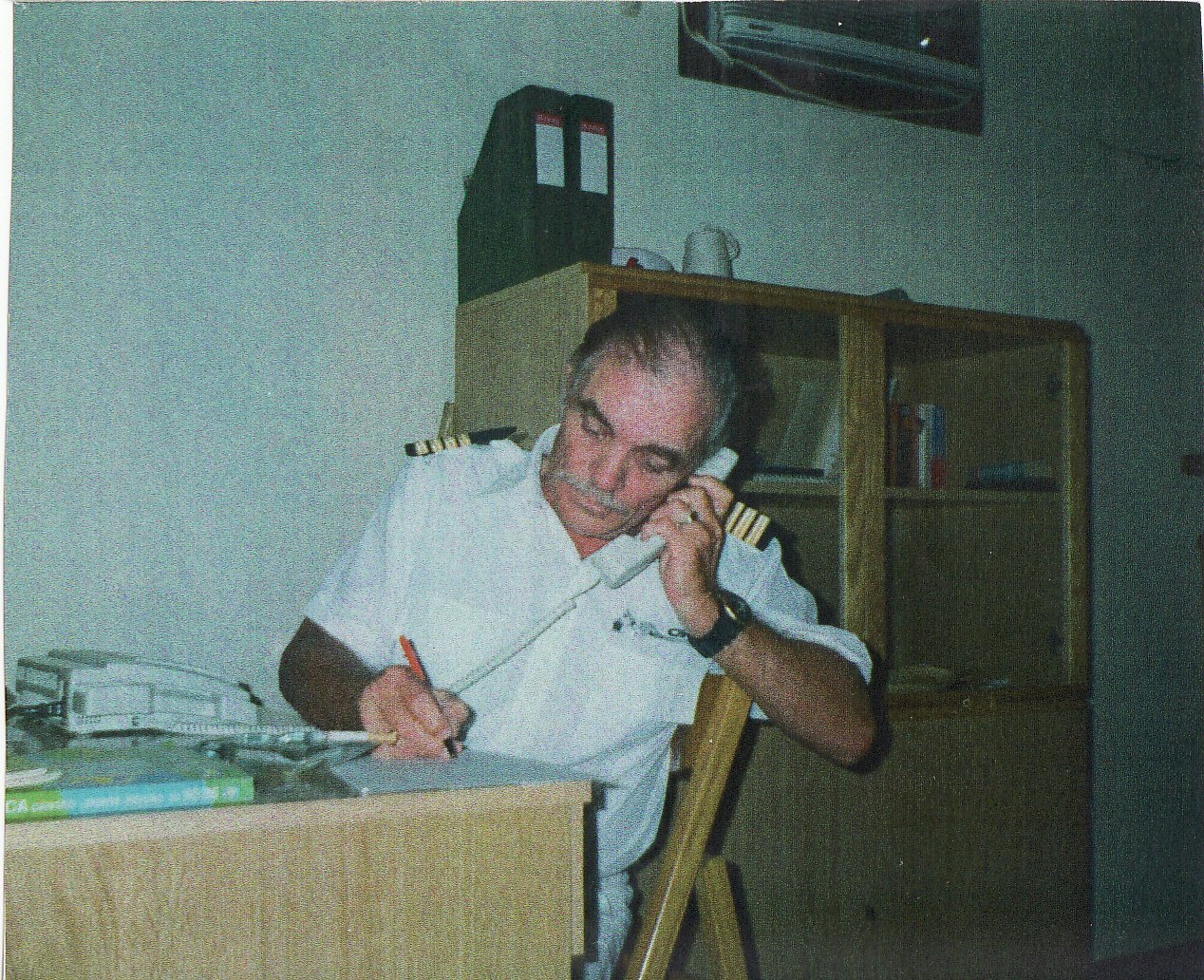
                                Myself Conducting ships business in Beira Mozambique 1992 

Wednesday, 14 October 2015

Transported like cattle on the s.s. Waratah.

 
On the arrival of the s.s Waratah in Melbourne at Victoria dock on the 18th of January 1908, the ship was met by a brave reporter who had been alerted from Adelaide that some passengers had taken legal action against the Lund Line for the poor and unsanitary conditions as well as the overcrowding they had to endure. The reporter went fore and aft eager to try and interview as many passengers as possible. A spokesman for the passengers said we were induced to book on this ship owing to the glowing advertisements inserted in the English newspapers. The steamer has only first and third class accommodation, and it was persistently stated that its "thirds" (cabins) were equal to "seconds" on any ordinary liner. She could comfortably carry 130 passengers in first class saloons, and 300 in her third class compartments. For that number the space allotted to in cabins and public rooms, and saloons is on a GENEROUS SCALE, but what is ample for those people is insanitary and suffocating for 700 or more. The company may not have expected such a rush of passengers, which included many emigrants assisted by the New South Wales Government, but whether they did or not doesn't matter. They accepted double the number they had accommodation and provisions for-pocketing the extra fares, which amount to 17 pounds apiece, with the result we suffered. After we were out two or three days we found the food supply insufficient. 
 
The stewards were also few in number, this occasioning inattention and lack of supervision. A deputation confronted Captain Ilbery and he tried to do the best he could. Some stowaways were discovered and a number of them were pressed into service as stewards, whilst passengers who would lend a hand were promised 2 pounds reward on arrival in Sydney,(they refused the offer,  in my new book I deal with this in full). The water was doled out very sparingly, the tea and coffee were very indifferent. Owing to the inadequate flushing  the urinal closets (toilet bowls) got into a terrible condition by the time we reached Capetown. The food supply was not good, and the sugar ran out, the puddings were unsweetened, as was the undrinkable tea. Fresh meat was a rarity, and greasy water was served up as soup. As to sleeping, ten men were huddled up in a space 10feet x 10feet x 8feet. There were no portholes in many of the compartments, and when crossing the line (Equator) the heat and discomfort endured was very great. Owing to the want of sufficient flushing water closets and urinals many men utilised one of the coal bunkers for the call of nature, but ultimately the coal bunker was eventually cleared out, and the erstwhile impromptu lavatory was converted to a dining room. Those poor trimmers were shovelling more than coal. As regards bathrooms, only doubtful water was supplied, and people could actually see the bathers from the top deck.
 
There were many women and children on board including about 30 girls who were being indented as domestic helps, over them was a deplorable want of supervision. In the stern there was an ill-ventilated compartment dubbed an "isolation hospital", its only ventilation was two port holes, one man died there during the voyage. (There were other deaths on board which I have included in my book with the official log book entries in connection with them), another man was on board the crowded ship was in the last stages of consumption. As regards the smokeroom, it was often unbearably crowded. It won't hold more than a couple of dozen, if comfort is studied, but sometimes there were fifty jammed into it. At the bar men were drunk and the permanent saloon often became a rowdy tap room,(PUB). The presence of women and children was totally disregarded by those who used bad language while "under the influence". Concerts were held occasionally, but there was not room for half the passengers. We do not blame the captain or his officers, who did the best they could under the circumstances. It is the shipping company we blame, who for the sake of a few hundred pounds in extra fares treated at least 750 people as we assert. Such is the substance of the complaints made by the third class passengers. The discomforts suffered are proverbial, and in an overcrowded vessel such sufferings must be intensified. The authorities upon board ship look upon  the whole genus of passengers as born growlers, but in this case the passengers think they have a reason to growl.
 
The plucky reporter gave publicity to the growl, as he was duty bound in the public interest, and leaves the statement for the consideration of his readers. While on board he inspected portions of the ship complained of, and what he saw as to accommodation and overcrowding fully bore out the passengers statements. The passengers were limited to a justifiable compliment, but under the extraordinary conditions on which the Waratah was permitted to make her maiden voyage the large dining room' had an adjunct the unsavoury coal bunker, (spar deck,) and the smoking room was a diminutive farce. An inspection of the closets and urinals showed them to be in a dirty condition , as alleged. The question suggests itself: is there no supervising authority in England to see steamers are not allowed to be overcrowd in such a shocking way, and inflict discomfort on the unfortunate passengers, besides, perhaps endangering life in the case of a disaster? The Board of Trade was the responsible authority and their servant Captain Clarke passed the ship as a suitable emigrant ship just as he passed the lifeboats as fit for service for the maiden voyage. 
 
                                                                           s.s. Waratah.
 
                                       No room for deck chairs with these 3rd class emigrants. 


Monday, 12 October 2015

The harlow evidence De-Bunked why?

The evidence given by Captain Bruce at the inquiry was dismissed by the Commissioner and his assessors due to a number of reasons, the main ones being that his chief officer did not agree with Captain Bruce and said "they were bushfires", he also went on to say, "that  if there had have been a ship on fire she would have been sending up distress rockets". The fact that Captain Bruce made no attempts to verify what he had seen and also that he made no report of his observations when arriving in Durban or during his stay, yet on the internet he is described as making enquiries about overdue ships. It is also on the internet  that he and  his officers failed to assist a ship in distress and conspired to do so by making all sorts of excuses in order not to turn about and go to the supposed ship on fire. Nothing could be further from the truth when closely questioned at the hearing as to why he did not report the event in Durban he replied that he did not do so for fear of being mistaken. This indicates that he was still unsure after a conversation with his officers wether it was a ship or not, I believe that if he was convinced it was a ship he would have turned about to assist,  he was presented some years earlier with a bravery medal for saving life at sea  which was mentioned at the hearing so he was not the sort of man to sail away and leave some one to die at sea. Captain Bruce said that on the 27th of July at about 5.30pm, just on dark he was 12 to 14 mile south of Cape Hermes when he noticed black smoke about 15 miles astern of him in the Coffee Bay area and saw two white lights which he  took to be masthead lights one above the other of a ship and also a red port light and it appeared to him to be a ship on fire moving rapidly up the coast.  Bruce himself was coasting, sailing close into the coast visually at about 1.5 to 2.0 miles off the beach and the alleged ship seemed to be more or further out to sea. If this was the case her masthead lights would have been open to the left of his starboard quarter, if she was dead astern of him the lights would appear in line one above the other, and if closer into the shore than his own ship they would have been open to the right on his port quarter but Bruce makes mention of either. The opening and closing of masthead lights at night gives the officer of the watch an indication of a ships heading. During the first world war some companies had one mast removed from their ships in order to not show a submarine if the ship changes course making it difficult for the sub captain to calculate a course to intercept the ship and put him into a position to sink the ship. Here we are talking about an unlit mast and only visible against a night sky line to the sub. 
 
Let us look at some critical questions and put the Harlow story to bed for once and all.
1. Why didn't Captain Ilbery put down lifeboats with the passengers close into shore if he had a raging fire on board this would have been his first duty towards their safety?
2.If the ship was on fire off Coffee Bay or that part of the coast why was it not reported at a later date by any white settlers in the area or local natives.
2. At what stage or point off the coast  did the s.s Waratah turn back on her course to Cape Town?
3.What could have caused a raging fire in a few short hours after leaving Durban, it could not have been the valves near the boilers because these would have been seen to when she was  docked for seven weeks in London after the first voyage.? 
4. It could not have been spontaneous combustion of wool, because this would have been noticed either before Durban by regular hold checks by an officer checking the cargo and lashings, and also when the hatches were opened up in Durban to discharge cargo.
5.A possible way a fire could have started in a hold would have been caused by the friction of metals in the hold setting fire to the timbers carried, or possibly the steel bands on the casks of tallow rubbing against each other with the motion of the ship and waves, and thereby generating enough heat to set the wooden staves of the barrel on fire then the tallow and eventually spreading to other cargo such as wool and timber.
6.Why did Captain Bruce assume the alleged ship was the Waratah? he could not possibly have known what ship it was because he had just crossed the Southern Ocean to South Africa on his way to Durban for coaling.
7. If there was an alleged ship behind the Harlow, why did it not attempt to signal the Harlow as it drew closer to the Harlow or fire of rockets to attract attention, a good lookout on the Harlow  would have soon spotted them.  Any captain with a ship on fire would be glad of any help he could get especially the unloading of his passengers and have the ship stand by until a solution one way or another could be found to his predicament. There would have been enough room aboard the Harlow for 211 persons.
8.Captain Bruce mentions the speed of the alleged ship was between 12 and 14 knots coming up fast behind him, how could he judge such speeds in the dark without the use of radar? any officer on watch will tell you it is difficult to judge distance at night and speed unless the ship is on a broad angle and regular bearings taken at say five minute intervals and plotted, one is then able to plot her course and speed a method relied on without the use of radar.
9.One writer wrote the ship was on fire because of the thick black smoke coming out of her funnel, when a steam ship is making thick black smoke from her funnel it is not because she is on fire but simply means the stokers were laying a few on her, (shovelling large amounts of coal into the furnaces to build up speed) or blowing tubes, (cleaning out the boiler tubes of excess soot), I have done this on many occasions during  my long years at sea.
10. Captain Bruce did say that he could not see any other lights to indicate it was a passenger ship, it was not only large passenger ships that carried two masthead lights but also cargo ships over 150ft in length, the mast lights in that period had to be visible for 5 miles with the aft mast light being 15ft higher than the foremast with the red and green sidelights to be visible for 2miles.
11. At 7.30pm the Harlow was abeam of Cape Hermes light and altered course more to the east for his run up the coast to Durban, at 8.0pm he came out from the charthouse and saw to red flares ups one about 300feet high and one about 1,000 feet high roughly about six miles astern of his ship, which he thought was bunkers exploding. After that he could not see the alleged ship which he estimated to be in Latitude 31degrees 38minutes south
Longitude 29degrees 35 minutes east, this is 1.5 miles due east of Cape Hermes light or in the mouth of the St Johns River.
12.It is said that the Waratah sank 7.8 miles north east of Cape Hermes, if this is the case that puts the alleged Waratah ahead of the Harlow, the Harlow would have only been 4.5 miles north east of the Cape Hermes light at 8.00pm after altering course at 7.30pm and doing 9knots, the alleged Waratah could not have possibly have been so far north at 8.00pm.
13. The position given by Bruce puts the said ship right under the nose of the lighthouse yet the light keepers neither saw or heard anything in the way of an explosion, this is excused by a writer saying the smoke from the bushfires would have obscured the keepers view, I doubt this being only 1.5 miles from the ship yet Bruce being 4.5 miles away could see the flare ups. If a ship had have been that close to the light he would have certainly sent up rockets at one minute intervals which would have been the prescribed white rockets by the Board of Trade, these rockets were white on their way up through the air and exploding loudly bursting open like a roman candle with white balls. they would not have been red rockets as claimed on the internet. Why didn't any one in the St Johns river settlement see a ship on fire they would have been close enough to see a ship on fire at sea.
14. I don't believe captain Bruce saw a ship perhaps he saw bush fires racing up the sides of hills at different heights, with regards to the white lights he may have been suffering from a medical complaint such as diabetes which can affect the eye sight. Perhaps he saw a star low in the sky or a light on the land which turned into two lights due to double vision which he thought were masthead lights. This condition can also be caused alcohol intoxication, cataracts of the eyes, smoking, sleep deprivation and strained eye muscles as well as  fatigue.
15. If there was a ship so close in  to Cape Hermes, surely with all the modern marine technology of today  why hasn't a wreck been discovered there?, for example trawlers in the area may have snagged nets on an underwater obstruction or located it on their sonar. Local recreation fisherman would have soon located it as it would have formed an artificial reef for fish that would thrive on the rich nutrients being flushed down the St Johns River. Why haven't  Navy ships found a wreck when surveying that part of the coast over the years?, and with the amount of scientific surveys carried out along that part of the coast it is a wonder they haven't also come across a wreck 1.5 miles or thereabouts near Cape Hermes not north of it.
 
                                                       Coffee Bay looking Northwards.
 
                                Entrance to St Johns River from the Cape Hermes Lighthouse.
 
                    Cape Hermes Light House 1908, Note keeper at the focal plane of the light.
 
           Ships in Durban Harbour Rafted together, ship second from the right could be the Harlow.
 
     Small cross alleged wreck, arrowed line Harlow's track, Large cross Harlow's  position at 8.00pm.


.