Saturday, 26 September 2015

Waratah Snippets.

On the second voyage of the s.s. Waratah homeward bound for London it was observed between Adelaide and Durban by passengers Mr. Claude Sawyer and Mr. Ebsworth a former merchant navy officer, that the Waratah tended to bury her bow into oncoming seas in calm weather and ship water for no apparent reason. It has been suggested that there being no external factors causing this it was due to her being overloaded, this was not the case as she was not overloaded. The Waratah did the same thing on her maiden voyage out and it was noticed  by a number of passengers. On the first voyage out in November 1908 a Mrs J Paton from West Australia in the course of a conversation with a news reporter, stated that the ship did not impress the passengers very favourably. She said, "the ship rolled more than any other vessel I have travelled in, and I have had a fairly extensive and wide experience". Asked if the rolling was discussed among the other passengers she said "yes". "At times the rolling of the ship occasioned some alarm even to seasoned sailors working the ship, and one gentleman discussed the matter with one of the engineers who explained it away by saying the vessel had not found her sea legs yet". Mrs Paton said "there was no rough weather  but there was a good heavy swell running most of the time".  "On several occasions when we were sitting on the deck in fine weather the vessel gave an unexpected lurch to one side, causing everyone to slide down the deck until we were brought up against the railings. Same thing happened on the second voyage when Miss Lascelle broke her arm against the rail. She appeared very slow in recovering herself, and the seas which were running did not appear to be sufficient to account for the ships behaviour. I went to South Africa on a White Star liner, and could not help contrasting the violent motion of the Waratah with the steadiness of the vessel on which I had previously travelled. On the way out there were deck games almost every day, but we seldom had any on the Waratah owing to the motion of the vessel.  The Waratah also had a knack of dipping her bows into the seas instead of riding them, with the result that in a head sea the propellers were constantly racing. I remember a much travelled New Zealander was very fervid in expressing the hope that we should not encounter any really bad weather in the Waratah, because he had a very poor opinion of her qualities. Personally I am not a nervous sailor, but owing to the general feeling of uneasiness which prevailed on board the vessel I was not sorry when I reached port". 
                                             
                                          MORE RUMORS OF GOLD ON THE WARATAH. 
 
In his recent blog Andrew Van Rensberg claimed that 105 tons of gold was loaded in Sydney with just over 2 tons of silver. There are no official records whatsoever of the Waratah carrying gold and silver, and if there had have been it would have been well publicised. In 1909 gold production had slumped to an all time low. For that year only 85.92 tons were recovered and of this, up until the 31st   of July 1909 only, 32.56 tons was recovered. For the whole year only 44.5 tons of gold was exported. I fail to see how 105 tons of gold was exported on the Waratah. For the whole year of 1909 only 4.9 tons in total of silver was exported. As a matter of interest the s.s. Pericles of the Aberdeen Line left Melbourne on June the 24th with 50 thousand pounds worth gold for South Africa which was shipped by the Bank of Australia. Most gold shipments went by the main carrier the P&O Company along with the Union Castle line, and the White Star line. The Waratah did not pick up any gold in Durban but what is interesting, is that largest shipment of gold ever taken out of South Africa was shipped aboard the Union Castle liner the Kidonan Castle. The gold arrived in Southampton  in August 1909, the value being, 1,143,271 pounds, also on board the ship was a Mr Claude Sawyer who  left the Waratah in Durban because feared she was top heavy and would not stand rough weather.  
 
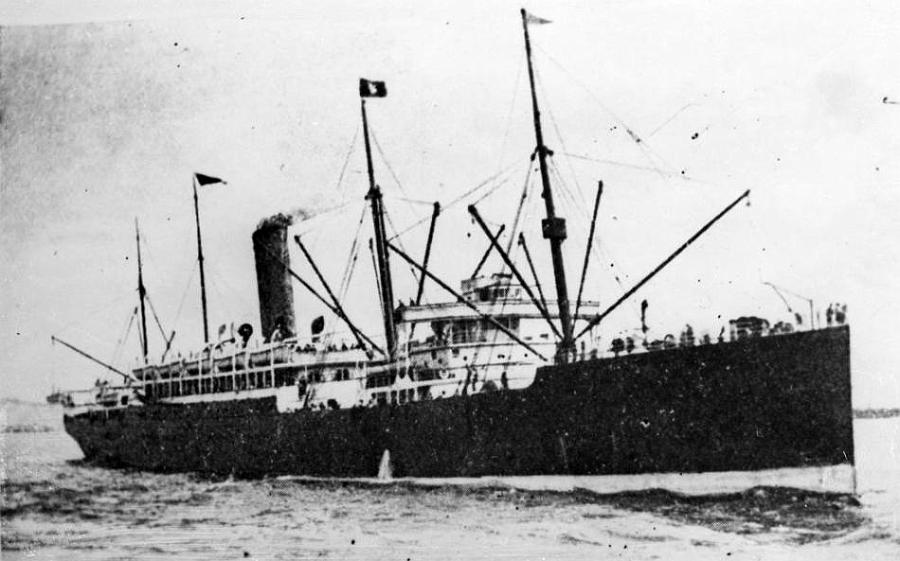
                                                                     s.s.  WARATAH. 
 
                                  s. s. WARATAH, with casks of tallow waiting to be loaded. 
 
                 s.s. KILDONAN CASTLE, note pilot ladder hasn't been taken in before berthing.
 
                       s.s. KILDONAN CASTLE, leaving DURBAN  with a slight list to port. 

Tuesday, 22 September 2015

The Loss of the s.s. Geelong.

 
The former Blue Anchor Line steamship the s.s. Geelong was sold to the P&O Company along with three other ships in 1910 when the Lund Company went into liquidation after the tragic loss of their flagship the s.s. Waratah off the South African coast in 1909. At the outbreak of World war one, the Geelong was taken over by the Australian Commonwealth Government as a troop transport carrier and was known as the H.M.A.T Geelong and assigned the carrier number A2. On the 1st of January 1916 at 7.15 pm the Geelong was rammed in the dark by the s.s. Bonvilston 2,866 Grt. According to the crew of the Geelong the ship was proceeding in the Mediterranean Sea bound for London with a general cargo which included tea but the bulk of the cargo consisted mainly of lead for the war effort. The weather at the time was calm and at 7.15pm it was very dark, the Geelong was steaming without lights so as to avoid submarine detection on the surface. The lookout failed to see the ship the s.s. Bonvilston which loomed up out of the darkness at full speed striking the Geelong amidships at a 90 degree angle. Such was the force of the impact that the Geelong heeled over and was rendered in a sinking position with a gaping hole in her port side. The Bonvilston went astern and stood off some distance away checking her own damage. The wireless operator on the Geelong immediately transmitted the S.O.S signal "we have been torpedoed". The wireless operator corrected this message once it was realised they had been hit by a ship and requested assistance. The watertight doors down below had been closed up well before the collision and helped her to stay afloat until she sank about one hour later.

All six lifeboats aboard the Geelong were kept swung out and at the ready in case of a submarine attack, these were launched at once with all the crew making it into the boats safely some still in their night attire. The lifeboats began to fill up with water at once owing to the fact that the timbers had dried out and the water came in rapidly through the seams causing the crews to bail  the boats out in a furious manner. The Bonvilston with her bows badly crushed bent and twisted was found not be in any danger of sinking due to the fact her collision bulkhead saved her. The crew of the Bonvilston eventually assisted the Geelong crew in getting aboard  she then made her way to her destination, the  port of Alexandria where she arrived  the next day. From Alexandria the Geelong crew made their way to Port Said where they split up with the British part of the crew leaving for London and the Australian members of the crew returning to Australia on the P&O liner s.s. Medina. There were 16 Australian crew members on the Geelong,  9 from  Adelaide, 5 from Melbourne and 2 from Sydney  all arriving safely home. The Bonvilston was on a voyage from Suvla Bay to Alexandria and had taken part in the evacuation of soldiers from Gallipoli and carrying supplies. The Bonvilston was built in 1893 for Thomas Radcliffe & Company of Cardiff  and was launched as the Anthony Radcliffe. In 1908 she was sold to Douglas Hill Steamship Company and renamed the Bonvilston. She was later torpedoed on the 17th of October 1918 by the submarine U92.

A claim was made by the Commonwealth for damages and was heard by a Mr. Justice Bailhache's  who found in favour of the Commonwealth by judging it to be a marine peril. This was appealed and in the appeal Court the Master of the Rolls delivered a judgment which held that the Bonvilston which collided with the Commonwealth liner Geelong in January1916, was engaged in a warlike operation in connection with the evacuation of Gallipoli. Therefore, the sinking was owing to a war risk, not a marine risk. Justices Warrington and Scrutton concurred in the judgment. The appeal against Mr. Justice Bailhache's decision was dimissed. 

                                            s.s. Bonvilston which sank the s.s. Geelong .

                                                                             s.s. Geelong.

                                 s.s Geelong leaving Hobart Australia with troops for Egypt.

                            s.s. Medina P&O ship which brought Geelong's crew back to Australia. 


Wednesday, 9 September 2015

The uncharted rock that did not exist.

                                   The loss of the s.s. Pericles near Cape Leeuwin West Australia.
The s.s. Pericles of the Aberdeen Line on the 31st of March 1910 when rounding Cape Leeuwin in Western Australia struck what was alleged to be an uncharted rock or obstruction resulting in her sinking without loss of life.
The s.s. Pericles was the latest addition to the Aberdeen Line and was under the command of Captain Alexander Simpson Commodore of the line, and a veteran of more than 80 voyages to Australia, he was also a friend of Captain Ilbery Commodore of the Blue Anchor Line and in command of the s.s. Waratah which disappeared in 1909. The Pericles had dimensions of 500 feet x beam 62 feet 3inches x depth 32 feet. She was fitted with 2 quadruple steam expansion engines and was built by Harland and Wolf of Belfast in 1907 at a cost 240,000 pounds and had a service speed of 14 knots. Pericles left Melbourne for London on the 24th of March 1910 after being delayed for three days by a coal strike. She carried a substantial cargo of 32,000 boxes of butter, 35,000 carcases of frozen mutton, 6,000 bales of wool hides, 3,000 cases of apples loaded in Hobart of which 500 cases were carried on deck. 25 tons of tallow and coconut oil, 600 tons of lead bullion, plus other sundries. The Pericles was laden to the extent that her forward draught was 27 feet 6inches and her aft draught was 26 feet 3 inches which meant she was heavy or down by the bow 1foot 3inches (badly trimmed which could effect her steering). The vessel and cargo was insured for 750,000 pounds, of which one third was for the ship, the other two thirds was for cargo 90,000 pounds of this was for butter alone.
 
In the late afternoon of the 31st of March the Pericles was steaming along at 14 knots when she struck rocks slowing her down to 8 knots, she hit hard tearing her bottom open for some considerable length and started to settle by the bow. Realizing she was sinking Captain Simpson ordered the ship to be abandoned, the seas at the time where calm, 238 passengers and 163 crew took to the boats which landed on a beach at a spot were the light house keepers indicated as being safe by marking the area with bonfires.  Captain Simpson claimed that he and his officers fixed the ships position earlier and claimed he was on a safe course, he also claimed that the ship eventually sank in 26 to 27 fathoms of water. At the subsequent court of inquiry conducted in Freemantle a finding on the 14th of April 1910 Captain Simpson was  exonerated of all blame. This caused a storm of protest in some quarters claiming that the inquiry was unsatisfactory and that it was a whitewash. The inquiry was held before Mr. E.P Dowley, Esq, Mr. W.A. Walter, Esq (both Magistrates), they were assisted by Captain Laurie and Captain F.L Parkes (assessors).  The first outcry was against Captain Laurie who should not have been on the inquiry due to a conflict of interest. Objection was made because Captain Laurie had business relations with the Aberdeen line in the capacity of a stevedore. Captain Laurie started his own stevedoring company in Freemantle in 1890, he was also Chairman of the Fremantle Harbour Board and had many dealings with Captain Simpson, on top of this he was accused of holding the monopoly on stevedoring by other companies in Freemantle. It was believed he showed partiality towards Captain Simpson and it was most undesirable for him to be acting in a judicial capacity at the inquiry affecting the professional reputation of Captain Simpson. Similar instances have been shown to take place in other inquiries. One in particular, is the inquiry into the loss of the Waratah which involved two naval architects.
Many witnesses not at the inquiry stated that the Pericles was to close to the shore and not on a safe course. The s.s. Strathfillan passed the Pericles off White Rocks opposite White Cliff. The captain of the Stathfillan was leaving the bridge when the third mate drew his attention to the fact that the Pericles was dangerously close  inshore, the Starathfillan was eight miles offshore and the Pericles to be four or more miles inside of him.
Mr. Charles Ryan a third class passenger stated, "after coming ashore by lifeboat we spent the night at Flinders Bay until relief reached us. The residents at Flinders bay expressed amazement at the Pericles course so near inshore and to use their own words", "gave her ten minutes before getting smashed up" and actually went down to the beach to watch the spectacle. "The local residents were sure it was Bevan reef which the ship struck". It is said that no vessels small or large ever come within 10 miles of where the Pericles struck, (Sailing directions recommend to ships rounding Leeuwin to leave a margin of 15miles). Captain Airy of the Government vessel s.s. Penguin was given the task of locating the exact position of the wreck. Captain Airy informed the Court that he searched over a radius of  3 to 5miles away from the shore,  at the start of the search and finding no traces of the wreck he decided to work closer inshore. The vessel was located by the mate of the Penguin who was searching in a smaller boat. Soundings were taken, and it was ascertained the wreck was lying in 18 fathoms of water not the 26 to 27 fathoms that  Captain Simpson had claimed. The wreck was laying E.S.E, and its position was fixed from the lighthouse bearing N 3degrees E (magnetic), with a distance of 2.6 miles from the light. Captain Simpson admitted in court that he wanted to signal the lighthouse by flags to notify Fremantle that he would require 150 tons of coal on arrival. In order for his flags to be seen he would have to have been about 3 miles off the light.
 
A number of passengers seem to have been alarmed at the nearness of the land both on the Tasmanian Coast and from Albany West Australia onwards. One passenger Mr. Hirman Florack stated he noticed a disposition to hug the coast and said " he would be glad to get to the end of the voyage if ever he did". Passengers Mr. and Mrs Fewster said " they thought the cause of the disaster was the ships officers were trying to make up time after the delay at Melbourne, and kept hugging the coast too closely". Another passenger who wanted to give evidence was told by Captain Irvine the Chief Government Harbour Master who practically Poo-Poohed the idea of him giving evidence, and declined him simply because he was not a nautical man, and therefore in his opinion not competent to estimate distance on water. One passenger travelling third class was a master mariner and refused to give any opinion on the matter what so ever. Obviously if he had have spoken out against the ship his future employment could well have been at stake if not a black ban imposed against him.
 
On the 8th of December 1910 the survey ship H.M.S Fantone searched for four days in an exhaustive  search and revealed no dangers outside of those charted existed. This information was then transmitted to the Board of Trade in London. Settlers along the coast were picking up boxes of butter washed ashore and offered the receiver of wrecks one shilling a box, cargo was strewn some 30 miles along the coast. Captain Simpson very much shaken eventually sailed from Freemantle aboard the Blue Anchor Line steamer the s.s. Wakool.
 
                                                               S.S. PERICLES.
 
                                                    CAPE LEEUWIN LIGHT HOUSE.
 
                                    S.S. STRAFILLAN NOTICED PERICLES TO CLOSE IN.
 
                                  REEF TO THE LEFT NEAR WHERE PERICLES SANK.
 
                              SISTER SHIP THEMISTOCLES REPLACED PERICLES.
 
It is interesting to note that the Pericles commenced her maiden voyage in the same year as the s.s.Waratah, the Pericles in July 1908 and the Waratah in November 1908. Having read the court of inquiry records I am inclined to agree that it was not the sea alone that covered up the Pericles.


Thursday, 3 September 2015

A burning question the Waratahs Coal.

There has been much confusion whether the Waratah carried coal on the spar deck, (also known as the lower bridge deck directly below the upper bridge deck where the ship is steered from).  The Waratah on leaving Durban for Capetown  did in fact have over 300 tons of coal on the spar deck. At a meeting to discuss the loading of the ship with Captain Ilbery, Mr. Owen the chief officer and Mr. William Robert Wright manager for Messrs William Cotts & Company the ships agents, Captain Ilbery instructed a representative of Messrs Nicoll & company coal suppliers to place about 250 tons plus, of coal on the spar deck. Captain Ilbery had been using the spar deck to carry coal as he now had a loading plan updated by the builders including updated stability data. The Waratah did not have 1,900tons of coal in hand on arrival at Durban as mentioned in the press. The permanent bunkers of the Waratah was 2,010 tons which he now depended on because he had lost most of his reserve bunkers 1,819 tons to a heavier cargo down below. For example No 3 lower hold on the way out from London held 859 tons which was used up prior to arriving at Adelaide, this lower hold was swept clean  by the crew and prepared for the taking in of 1,000 tons of lead concentrates  for stability reasons. The lead concentrates in this space were stacked 8 feet high at 12 cubic feet per ton. There was no need for the Waratah to carry her full compliment of coal 3,829 tons and was now dependent on her permanent bunkers with most of the reserve bunkers taken up by heavy cargo. Further proof of the spar deck bunker being used for coal arose in Melbourne when Captain Anderson of the Victorian stevedores in company with Mr. Owen the chief officer inspected the spar deck, Captain Anderson measured up the spar deck in case it would be needed for cargo and found there was 11,944 cubic feet of space, the remainder of the spar deck was taken up with coal about 300 tons. No tallow or wool was at any stage placed on this deck during the present  voyage, it was the maiden voyage that these goods were placed there on the homeward leg of the voyage to London. The Waratah could get by with the 2,378 tons of coal when she left Durban with ,as she would top up in Capetown to make up the coal burned between Durban and Capetown. From Capetown her next port for topping up her coal was Las Palmas in the Canary Islands a distance of 4,192, from there to her home Port London was a run of about 1,563 miles. These ports were used as coaling ports on a regular basis and Mr. Lund owner of the Waratah had a business associate in Las Palmas that sold him coal cheaper than he did to other ships.
The Waratah was by no means overloaded otherwise she would not have been allowed to leave port, her mean draught on leaving Adelaide 28feet 8"inches and exactly the same when leaving Durban. Her draughts in these ports were always read by a government official and if she had have been any- were past her Plimsoll mark she would have been prevented from leaving port and the captain heavily fined , her maximum draught was 31feet 6''inches, so she was well inside the maximum draught, When she left London on her maiden voyage she was loaded with 8070 tons of coal and cargo with a mean draught of 27feet 9"inches . The Court of marine inquiry was well aware of the coal on the spar deck as it was well discussed especially about the confusion of the bridge deck. A great deal of confusion in this regard was created by the newspaper reports and reporters that did not posses any expertise in the complexities of shipping or stability, so much on the Waratah has been miss-reported. Before leaving Durban the Waratah had a slight list and captain Ilbery wouldn't leave until the ship was upright, the cause was that the coal had to be trimmed, this would have been the coal on the spar deck as the permanent coal down below would have been well and truly trimmed earlier.
 
                                               Trimmers with shovels ready for work.


                                                                     Port of Las Palmas.


Saturday, 29 August 2015

Was there 300 tons of gold bullion aboard the Waratah.

Recently I received an email asking me if I knew of the rumors that the Waratah carried 300 tons of gold on her last voyage to London when she disappeared off the coast of South Africa in July 1909 which could have resulted in the hi-jacking of the ship. To answer the question I made exhaustive inquiries at the Bank of England into the records held there and also in Australia, but could find no record of any gold being shipped aboard the Waratah or of any specie of any kind, (gold, silver or coins). The Blue Anchor Line ships  over the years did carry small amounts in their strong rooms and this was usually published in the press, gold sovereigns minted here in Australia were often carried to South Africa for distribution in that country. Waratah on her last voyage did load in Sydney 300 tons of lead bullion which was placed in No 4 lower hold and in the hold just before the bridge. The bullion was automatically thought to be gold, the word bullion has obviously confused some people but base metals such as copper, nickel, zinc and lead were often referred to as bullion in the form of ingots. Looking at the prospect of carrying 300 tons of gold would in itself would produce logistical problems. The space that would be required to house such an amount, the weight and where it would be placed for stability reasons, the guarding of such gold and manpower required for the voyage. The specie or vault room on board the Waratah was certainly to small being about 110 cubic feet 2.75 tons, plus who would take the insurance risk on such an amount of gold which would have been worth 12 million 902 thousand 400 pounds in 1909. If there had have been that amount of gold on board the insurers would have certainly let it be known in the hope that a salvage company would step forward to recover it if possible, with a large share for themselves. If ever the Waratah was found and it proved to be in very deep water there would be no salvage value in trying to recover the lead and 75 tons of copper ingots on board, the cost of recovering these items would not be a viable proposition. 
 
                                         Lead bullion to be further refined to 99.7 pure lead. 
 
                                                  Gold bullion in the Bank of England vault.

Wednesday, 26 August 2015

The collision of the Pisagua and the Oceana

On the 12th of August 2015 Andrew Van Rensberg posted an interesting blog on the collision of the Pisagua and the Oceana, I should like to add further to the event.
The Pisagua was a German barque of 2,906 grt with a length of 370ft 9inches x beam 44ft 7inches x depth 26ft 1inch. she was driven by 38,000 square feet of sails and was under the command of captain R.Dahm. Built of steel in 1892 she was carrying 4,500 tons of nitrates from Mexillones (Chile) to Hamburg Germany.
The Oceana was owned by the P&O Company a passenger cargo ship 6,610 grt x beam 57.15 ft x depth 26ft 6inches with a steaming speed of 14.5 knots. She was under the command of captain Thomas Hide and was bound from London to Bombay India. Oceana had a crew of 221, and was carrying 15 first class passengers, 26 second class (21men, 18women and 2 children). On board was specie in the form of gold and silver ingots valued at the time to be worth 747,110 pounds. The Oceana left Tilbury for Bombay at  2.00pm on the 15th of March 1912. About 2.56am on the 16th of March, she passed the Royal Sovereign light ship at about 3 miles off. A course was then set, S83W true. The weather was described as fine and clear with a north fresh wind. Beachy Head was abeam at 3.28am. In accordance with the usual arrangement the pilot was to continue to act until the ship reached the Nab light vessel. From midnight to 4am Mr. Walter Naylor the chief officer had the watch, he also held a masters certificate. Shortly after passing the Royal Sovereign light ship the pilot left the bridge to sit down in the chart room, he notified the chief officer and said, "keep a sharp lookout and call me if you need me". The vessel at this time was steaming at 14.5 knots.
 
At about 3.55am the chief officer was examining some lights on the starboard bow when he heard the gong in the bows strike once, the signal from the lookout indicating that there was a ship on the port bow. Mr. Naylor looked at the ship through his glasses and made her out to be a sailing ship under plain sail almost on opposite course, showing her starboard side open. A blue flare was being burned on the sailing ship and by its light he could see she was running free with her sails on the port tack. He judged her distance to be 1.25 miles, and she bore two points on his starboard bow (22.5degrees). At first he did not see the green light but as the blue flare burned down he saw a dim green light. He gave the order "port five degrees" but did not signal with the ships steam whistle as to what he was doing. The pilot came out of the chartroom and said, "what are you porting to"? the chief officer replied "the ship burning the blue flare". The pilot quickly looked at the ship and gave the order, "hard a port". The order was repeated by the helmsman and the helm put hard over. It was of course to late and the Pisagua struck the Oceana at an angle estimated by the chief officer to be almost a right angle. The Pisagua struck the Oceana  about 18 feet before her foremast with her bowsprit coming over the Oceana. The Pisagua rebounded before coming near the bridge of the Oceana again striking just before the break of the bridge, and sweeping away all the lifeboats on the portside except the after boat No 10. Her plating was torn away for about thirty feet, the cabins in the vicinity of the blow were all wrecked. The second officer was sent to check the damage and observed from the main deck that the top of the waves were entering the hole in the hull. regular soundings were taken of number 1 hold until they reached 33 feet. When both vessels were free of each other the captain and the chief officer both thought the ship was rapidly sinking, with the passengers on the captains mind he ordered the remaining boats made ready. The chief officer misunderstood the captain and lowered the No1 lifeboat down to the spar deck where 16 passengers and 2 crewmen boarded it. On reaching the water the boat, almost at once took a sheer out from the ships side. The after rope fall was released but no painter had been passed forward to the ship,(rope attached to the lifeboat). The ship started moving forward, the life boat was still connected by the forward rope fall and could not be released and boat capsized by being dragged along and threw all 18 people into the sea drowning 17 souls. There was no lifeboat equipment in the boats and an axe usually kept in each boat had been taken out for fear of theft. if there had have been an axe in the boat the seamen could have cut the rope fall and may have saved the boat from being upset. Prior to sailing two Board of Trade surveyors on separate occasions visited the ship to test her boats in the water. Neither of these two surveyors inspected the lifeboats equipment which should have been in the boats by law. If they had have done there job properly the axe would have been in the boat concerned. 
 
The Oceana eventually sank due to the master insisting on the ship being towed when all advice to beach her while she still had flotation was ignored. The Pisagua was damaged to the effect that her bows had been crushed back 17 feet. It was only the strength of the No 1 hold bulkhead holding out saved her. She was towed back to Dover by two tugs. On arrival she was promptly arrested by having a writ attached to her mast to ensure payment for the salvage and towage by the tugs. Pisagua was named after the port of Pisagua in Chile where ships since 1860 came from all over the World to load nitrates. 
The cause of the collision was the fault of the chief officer in attempting to cross ahead of the Pisagua, (steam must give way to sail), he was also found responsible for the  deaths of the 17 people that drowned, his certificate was cancelled for six months with a strong censure. 


                                                  Pisagua showing her code letters R.J.P.T.
 
 
                                                          The badly damaged Pisagua.


Thursday, 6 August 2015

Waratah gossip from Barclay & Curle shipyard.

Mr. William McPhee was a chief engineer at sea until he retired to America and began a career as an author writing books mainly about the sea and ships. He is a very well known author world wide and has many books to his name. In 1910 he was on a ship that tied up in the Queens dock Glasgow at the foot of Finniestoun Street in full view of the Barclay & Curle fitting out basin. At the time there was an ex Blue Anchor Line ship at the berth which was the Geelong being converted from carrying 450 steerage class passengers to a larger capacity of 700. At the time a young cousin of Mr. McPhee was an apprentice in the engine shops of Barclay & Curle, his cousin told him he had worked on the Waratahs engines and was on board for the sea trials. He said " everyone in the yard knew she was extremely tender and it took very little to make her list."
What we do know is that during the engines trials Mr. Hodder the chief engineer ordered a section of the main steam line be replaced as he was not happy with it.   
 
                                                     Chief engineer William McPhee.
 
 
                                                             Barclay& Curle fitting out berth.