Tuesday, 26 July 2016

         s.s. WARATAH ONE HUNDRED AND SEVEN YEARS LATER ON.
It is one hundred and seven years today since the s.s. Waratah a passenger cargo ship vanished with 211 persons on board in 1909, leaving no trace of her last position on the face of the Earth. As an individual I have chosen two poems of remembrance, one for the passengers and one for the crew. 
                                       For the passengers.
                                                     IN OUR HEARTS.
                                        We thought of you with love today.
                                        But that is nothing new.
                                        We thought about you yesterday.
                                        And the day before that too. 
                                        We think of you in silence.
                                        We often speak your names.
                                        Now all we have is memories.
                                        And your all your pictures in frames.
                                        Your memory is our keepsake.
                                        With which we will never part.
                                        God has you in his keeping.
                                        We have you in our heart.
                                                                                           Author unknown.
 
   For the crew adapted from the Lords Prayer.
                                                        The Pilots Psalm.
The Lord is my pilot, I shall not drift, He guides me across the dark waters. He steers
me in deep channels, He keeps my log. He pilots me by the star of Holiness for his names sake. Yea, though I sail mid the fender and tempests of life I shall dread no danger for He is near me. His Love and care shelter me. He prepares a harbour before me in the Holiness of Eternity. He anoints the waves with oil, my ship rides calmly.
Surely sunlight and starlight shall favour me in my voyages and I will rest in the Port of our Lord Forever. 
 
                                             Waratah at berth A Albert Docks London March 9th 1909,
 
                                                          Long ago but not forgotten.
 
                              N.S.W Emblem the Waratah flower which the ship was named after.
                                   s.s Waratah last seen off the South African Coast July 27th 1909.


Sunday, 10 January 2016

More on coal and steamships

                                                       More coal on ships decks.

Coal on a ships hatch in a storm, notice coal all over the deck this usually ends up blocking up the scuppers and prevents water from running of the deck.

 
                              A much more sensible way to carry extra coal, easier to handle.

Two things I hated as a young man at sea and that was loading bulk wheat and coaling the ship, prior to loading either we had to cover the vents close up all doors, windows, portholes, cover electric motors, close all the skylights on deck. No matter what prevention you took the dust always managed to find its way inside the ship covering everything with a fine powder. It was even worse in the tropics as the ship heated up internally and made life unbearable below decks without ventilation.
 
The ss Waratah loaded coal on board in three ways, directly down the hatches on deck, through coaling port doors on either side of the ship and by lifting coal up onto her boat deck with four derricks ( cranes) on the deck solely for that purpose. The coal hauled up onto the boat deck was then tipped in to the two hatches on that deck, one aft of the funnel and one in front of the funnel. Canvas covers were put over the rails to prevent any damage to the teak railings and to prevent coal pieces landing on the deck below. As each basket of coal was brought over the rail it was place on a wooden trolley and wheeled to the intended hatch on a set of tram lines laid down on the deck. Each basket was counted as it arrived by a tallyman for the coal contractor and also by a member of the ships crew. One basket weighed one hundred weight (112 pounds- 20 baskets= 1ton).


             Coal being loaded aboard a Japanese ship, using the same method as that of the Waratah.
In the picture we see coal being loaded on a more modern steamship through the top deck, this hatch is directly behind the funnel. Note on the left we can see the hatch boards and a canvas cover laying on the closed engine room skylight. As the coal is tipped in there are men standing on the sides below ready to trim or spread the coal evenly in the bunker.

ss Waratah, if you look up at the boat deck you will see two derricks at the side of the funnel, these are two of the four derricks on the boat deck used for lifting coal onto that deck.

In this picture we see men coaling the ship through the side coaling ports or doors, a set of lines were attached to the ship with running blocks and ropes which allowed the coal bins to be hauled up and the coal poured down the chutes to the trimmers down below who levelled of the coal for stability. On completion of coaling these doors were closed after sealing with red lead and tightened up from the inside by crew members who had to crawl into a small compartment and an uncomfortable body position to do so.  Engineering officers relied on the trimmers word to say the ports had been properly closed and were watertight before informing the deck officer the ship was secure. Being below the main deck line and close to the water if they were not sealed properly water ingress was a danger and has resulted in ships taking water and causing a list. The question was raised  in Court as to whether the Waratah had her ports properly closed up, of course we shall never know.

Due to my editor of my book insisting that the book should be a single book and not Volume 1 and 2 as I intended, condensing it into one book is taking more time than previously thought, however I shall inform the readers as the time draws near to publication. 


Thursday, 17 December 2015

Some Interesting photo history.

Reading about ships of the Waratah period is not enough and leaves a lot to the readers imagination of what things really looked like. I have put a series of photographs from my personal collection to help readers to understand how things appeared in that period.  (note all photos are copyright and may not be used without my express permission).
We often read about ships carrying coal on deck for extended voyages but never see what coal on the deck really looks like, in this example I have selected two pictures involving the Ropner's tramp steamer Burnby  built in 1905.

About 250 tons on hatch No 1 and 2.
 
            s s Burnby,  Ropners  Steamship Company sank by U boat 39 North of Sardinia 1917.
 
                                  A bunker fire with smoke coming up through bunker grating.


         Passengers boarding Lund's ss Commonwealth in London. Note life boats not painted white        also another Lund ship in picture s s Geelong.
 
                              s s Commonwealth leaving London docks with third class passengers.
 
                                                    s s Commonwealth arriving at Adelaide.

        A beautiful ship, sister ship to the Geelong the s s Commonwealth discharging ballast water.

                                 s s City of London often mistaken for the Waratah at sea.
Note the high vents on the fore deck and similar wheelhouse.

In My Next post I shall put up some more interesting pictures of the Waratah period. The s s Commonwealth eventually had her lifeboats painted white at a later stage.


Tuesday, 8 December 2015

Waratah

One of the passengers on the first voyage wrote to the press the following.
To the Editor,
Sir, since this vessel arrived in Australian waters the company has raised the price of a pint of ale from 6d to 1s., quarts to 1s 6., and whisky 6d to 8d, Don't you think this is red hot, seeing we are only poor third class- class passengers? By the way, what is the duty the company have to pay in comparison to the extra charge they have put on us? We have been supplied with the cheapest bottled beer to be had in England during the voyage, with the exception of now-we are using a reputable brand, as all the other has run out. Another thing, this vessel is apparently top heavy, and I consider she's dangerous, as the way she rolled since leaving Capetown is a fair caution. Over 80 dozen glasses have been broken alone, besides other gear in proportion, Yours etc a third class passenger. It's interesting to note that Mr Skailes the chief steward received a percentage of all beers and spirits sold, no doubt he had his hands out on this one.
 
 
Beers of the period.
 
WARATAH AND HER FREEBOARD.
 
Waratah had a free board of 8 feet which was assigned to her by Lloyds and considered high enough above water level for a ship of her dimensions. The calculation of freeboard is a complex one worked out by the naval architects that made up the board in authority such as Lloyds and the Board of Trade. It would not matter if her freeboard had have been slightly higher she would have still shipped green water at some stage. Some ships have open rails on the lower well decks which help greatly in green water shipped running off quickly. The Waratah had plated bulwarks 4feet 2inches high instead of open railings. These bulwarks had three wash ports on either side of the well decks to allow the water shipped  to run off through, as well as scupper pipes to help the final draining of the water. These wash ports consisted of swinging hinged steel flaps that opened outward to let the water off the deck. They measured 3feet 6inches wide by 1foot 6inches high.
 
 
                                     A wash port with a ring bolt to hold it open if need be. 
 
One ship I was on had high bulwarks with wash ports and every time we shipped green water the well deck would fill up and before the wash ports could clear the amount of water shipped, another one would come over and you could feel the ship labouring and trying to rise to the sea with the extra weight, this was because they had not been maintained properly and did not open fully, they were partly frozen on their hinges. I took photos of the seas over the deck and when I returned to our home port I complained to the marine superintendent that it was dangerous and we could lose a man overboard, not only that, the ship was slowed up and straining and using far to much fuel according to the engineer and putting our E.T.A behind. In shipping time is money, thankfully he saw the problem and went back to head office to report our complaints. He appeared the next day and we decided remove the wash ports completely and weld three evenly spaced bars across the now new openings to prevent a man being washed through the open ports. Evidently the bean counters at head office didn't like the idea of extra fuel costs never mind about the added weight we had to struggle with or the poor bugger that might be swept overboard.. Eventually it proved worth while and the ship seemed a bit easier to handle and less strain on her. I believe according to the engineers figures the fuel bill over a year was reduced by at least 3%,
not a bad saving dollar wise.
With the Waratah and her forward well deck,  if she shipped green water and was unable to get it to run off before the next wave came over she would be weighed down by 250 tons of water by calculation, and this is with the cubic volume of the large hatch coaming subtracted. She was hard to steer under  favourable circumstances, can you imagine the after well deck filling up at the same time, I would say she would have been close to un-manageable steering wise. She had enough buoyancy when leaving Durban according to her draught, and she was no where down to her load her load line rated at 30 feet 4/2 inches.
 
            Open rails, water managing to run off more freely than a ship with plated bulwarks.
 
                                                               Open ships railings.
 
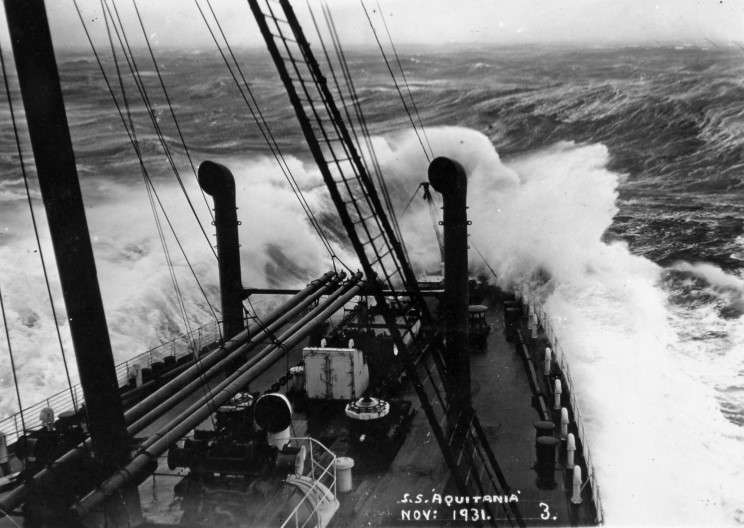
Let us now take a look at a larger ship than the Waratah with a much higher freeboard, the Aquitania was a large ship in her day with a very high freeboard  and she measured 901 feet long by 97 feet beam with a draught of 36 feet.
 
                                                  Aquitania with a very high freeboard.
 
                                                  Aquitania burying her bows into it. 
 
                        Aquitania getting rid of a green one , note the wash port at lower left of photo. 
 
It is interesting to note that the Clan Macintyre 2 during the storm had to open her gangway gates on her bulwarks to help get rid of some of the green water she was shipping.


Sunday, 22 November 2015

A rather insulting email .

To my Readers,
from all the many emails I receive on a daily basis regarding shipping matters and also the ss Waratah, I can honestly say I am disgusted by the one sent by Andrew Van Rensberg whom I have on the odd  occasion  pointed out mistakes (obvious ones) in some of his blogs. It reads as follows,
So glad your health is improving. MOLE, who is a female yes, has her own blog, MOLE'S GENEOLOGY BLOG. When the bickering is all said and done and I am unilaterally put in my place by an EXPERT, take a moment to read MOLE'S posts. They are informative accurate and most importantly an example of how to set the bar high. We can all learn from this,...... enough for now, back to my task of 'sweeping statements and feeding the public incorrect figures. Take care.

A lot of people are aware of your figures etc, Having insulted me privately Andrew, you start sending me emails about my earlier blogs being complimentary and now in public in your blogs, you are praising my posts in an acclamatory manner a far cry from earlier comments in the public forum, calling me a spoilsport, agreeing with MOLE that I am a nit picker. Attack is always a good means of defence when you are made aware of your short comings. However I shall continue to write on with good grace and dignity , but in the meantime  I would like to point out that I do not wish to have my name used in your posts in future for whatever means, or to be associated with  you in way whatsoever.   Captain S. J. Robinson.
To those that follow my posts I will be posting this week once again, and have some interesting articles lined up for you, and thank you to those of you that have offered kind words of support.
     

Wednesday, 11 November 2015

Top heavy ships, add some ketledge.

 
Ketledge, usually comes in the form of pig iron billets and was often used as ballast in larger ships. Ballast comes in many forms and did so before the introduction of water ballast in early steamships. Sand , mud, rocks, and foundry dross were often used but the effort of loading it and discharging it by shovel was costly and time consuming on ships wishing to spend less time in port. I was not aware of foundry dross until I spent some time on Ascension Island in the South Atlantic Ocean. During my stay en-route to South America. I became friendly with one of the local inhabitants who brought to me one day what appeared to look like a piece of clinker (hardened ash or partly burnt coal) from a ships furnace.  It had speckles of what I thought was brass in it and the local thought it was gold and it was very heavy for its size about 5 inches in diameter and 1inch thick. We took a hacksaw to it and found more of the shiny metal was right throughout . He told me that he was diving and came across a massive patch of it in amongst some old ships timbers, he also produced some heavy copper fastening bolts. It was now obvious that he had found and early shipwreck, and naturally kept the spot to himself. I was very curious as to what the clinker could be and at his request would I take a sample with me to determine what it was. This I duly did this and after eventually arriving in England on my way home, took it a marine archaeologist who informed me that it was dross from a foundry that probably  cast bronze cannons and fittings for early sailing ships and was used as a heavy ballast in wooden vessels. The main content in the dross was bronze and I duly messaged my friend on the island and he  replied that he was going to salvage the remainder for the bronze content as scrap metal. This was my first lesson in unusual ketledge as I knew it.  
 
                                                   Unstable M.V. Rangitiki.
The M.V. Rangitiki was a New Zealand  passenger ship one of three in the same class, launched on the 29th of August 1928 ,on sea trials she was found to be unstable in ballast. Before her maiden voyage was undertaken some topside weight was removed. Modifications were made which included the removal of two sets of Samson posts, (Strong pillars fixed to the deck for the support of ships derricks). On the 31st of January 1929 she was taken over by her owners and set sail for New Zealand on February 15th 1929 taking 5 weeks for the voyage. During the 1st voyage stability problems were still found to exist and on her return to England she underwent further alterations. These consisted of removing most of the bridge structure including the associated deck, shortening of her two funnels and the installation of additional permanent ballast. After this the ship went on until scrapped in 1962. 
                                                        Rangitki with high funnels.
                                                  Rangitiki with cut down funnels.
 
The ss Imperator.
On her sea trials stability issues were discovered but she still sailed on her maiden voyage from Germany to New York on the 10th of June 1913. On her arrival at New York the pilot Captain George Seeth noted that the ship listed from side to side when helm changes were made to her change of direction. It wasn't until October 1913 that the Imperator  was returned to the ship yard that built her to have alterations made to improve her stability which was caused by her centre of gravity being to high. The marble bathrooms in 1st class were removed along with all heavy furniture and replaced with light cane furniture. Her funnels were reduced by 9.8 feet (3metres) and 2,000 tons of concrete were poured into her double bottoms as fixed ballast.
I
 
                                   Imperator (leaning Lizzie docking at New York.
 
                                            A true birds eye view of the Imperator.
The ss Principessa Iolanda.
The ss Principessa Iolanda was launched in Italy at 12.25 pm on the 22nd of September 1907 and was almost at the completion stage. After leaving the slipway the ship became unstable and heeled over to port. Some 20 minutes later the vessel began taking in water (Downloading) through open ports. She eventually capsized and lay at 90 degrees. There were many errors caused during her launching but the main error seems to be launching an almost complete ship without ballast, it was denied that it was due to her design.
                                                      ss Principessa Iolander
                                                     Launching in progress.
                                                                 Starting to take water.
At rest at 90 degrees, could you imagine the Waratah recovering from this with cargo on board that would have shifted in heavy seas along with water rushing in through her vents and openings. It would appear beyond any shadow of doubt that in this case the righting lever (GZ) is no longer apparent. Hope the men in the picture are not looking for it.(please excuse my sense of humour). Readers can view Wikipedia for information on the three ships mentioned here.
 
                                                   A comment on stability.
You can play around with all the figures on the stability of the Waratah but I am convinced that not all the true figures were not  put into the public arena, if she was such a wonderful stable ship what happened to her? It is impossible to thoroughly determine the stability of any particular ship using commonly published specifications. It must be remembered that stability is so complex and influenced by so many factors that even professional ship designers find it hard to quantify. Before computers were available the calculations involved were so complicated that certain aspects of stability were only estimated rather than accurately determined. When reading the figures on the Waratahs stability presented to the court this is what precisely happened. In this present age of computers doing the workload on numbers, stability calculations are one of the most trying tasks the naval architect has to contend with and perform.   


                                                                      .


Monday, 9 November 2015

To the many readers that follow my blogs.

Thank you to all those readers for their lovely get well emails. I have had a spell in the sick bay but my doctor assures me that I am not ready to pass over the bar just yet. It is so nice to be back on deck and  in the relative comfort of my quarters once again. To those readers that sent emails regarding information on ships in general and also queries on the Waratah, I have cut back my work load but will get around to answering you in the near future. To those of you  requesting information as to where you can find information on the Court of Marine Inquiry, there is a 23 page annex to the full report of the ss Waratah available on line. I must remind you however it is only a short annexure but will give you some interesting reading on the case. The full report is held at the Guild hall in London and is a very lengthy document indeed. If you go to Google and type in "Wreck report for Waratah', 1909-Port Cities Southampton you will bring it up, (the short annexure only).
 
During my absence I have evidently been a naughty boy for pointing out some of the mistakes that Andrew Van Rensberg has posted in some of his blogs, especially a recent blog "Waratah continued part 8". Readers can refer to the comments on this blog and make up their own minds. One blog which I have taken exception to was posted by a female who blogs under the name Mole, in her blog she had the following to say to me. "Pointless having a go at Andrew who is producing an informative and unbiased blog for our delectation and delight. If anyone wants to take issue with the nuts and bolts of the stats, fine. There is such a thing as nit picking. Anyway we're all on the same side- that is the Waratah- aren't we"?
My answer is yes Mole, and in reply to your arrogant response we are on the same side when it comes to the Waratah, nit picking as you call it has saved many lives at sea, someone has to take issue with loose nuts and bolts otherwise everything comes loose and eventually falls apart. If my constructive criticism is seen as nit picking so be it, the public is entitled to correct information and there is no room for loose nuts and bolts. I will not see readers fed incorrect figures or sweeping statements thrown around loosely on nautical matters whatever the ship being discussed, (near enough is not good enough).

To my dedicated readers, my next blog will be on stability in a form you will readily understand, until then once again thank you for your good wishes.

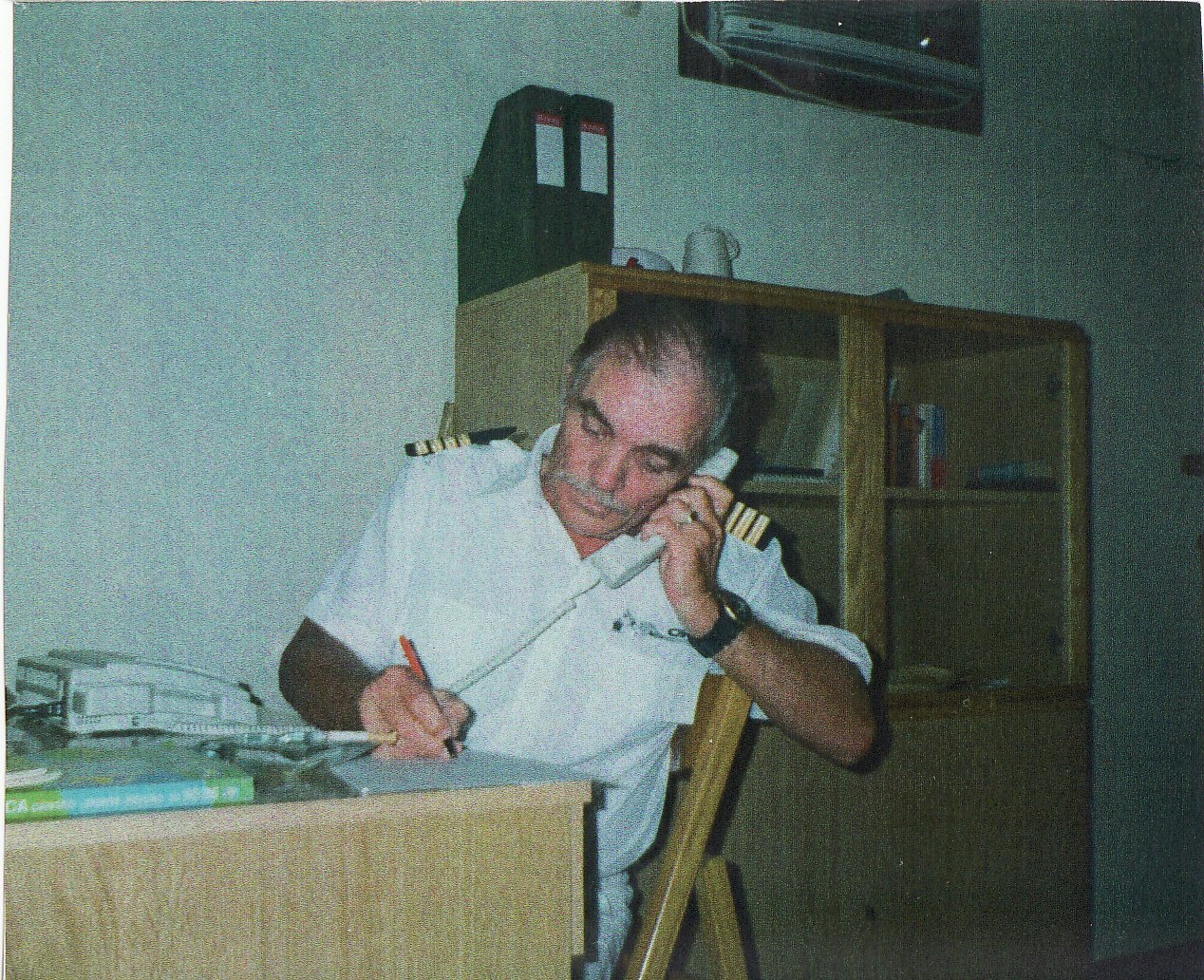
                                Myself Conducting ships business in Beira Mozambique 1992